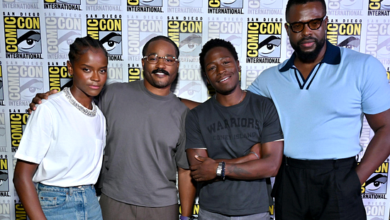
Joe Alwyn takes on a small but memorable role in Yorgos Lanthimos’ 2024 film Kinds of Kindness. Unlike a conventional movie in which an actor plays one character from beginning to end, Alwyn appears as three different characters across the film’s three interconnected stories. One of those characters is Jerry, who appears in the second story, titled “R.M.F. Is Flying.”
Kinds of Kindness is an unusual film built around three separate stories that share the same ensemble of actors. Joe Alwyn appears alongside Emma Stone, Jesse Plemons, Willem Dafoe, Margaret Qualley, Hong Chau, Mamoudou Athie, and Hunter Schafer. The film was directed by Yorgos Lanthimos and written by Lanthimos and Efthimis Filippou.
For Joe Alwyn, the project offered an opportunity to work with Lanthimos again after The Favourite. It also gave him a chance to approach three very different characters without relying on the usual methods of building one long-form role.
Jerry is particularly interesting because his screen time is limited, but his appearance becomes part of one of the film’s strangest and most uncomfortable sequences. Alwyn himself has said that the Jerry scenes were among the most fun parts of the project for him.
Who Is Joe Alwyn in Kinds of Kindness?
Joe Alwyn has three credited roles in Kinds of Kindness. They are Collectibles Appraise Man 1 in the first story, Jerry in the second story, and Joseph in the third. The official production notes for the film confirm all three credits.
The structure of the film is important to understanding why the same actor appears in multiple roles.
Kinds of Kindness is divided into three stories. Each story has its own characters and situation, but the same group of actors returns in different roles. Rather than following one continuous narrative, the film creates a kind of anthology in which the performances and recurring names and ideas create connections between the separate sections.
For Alwyn, this meant he had to make three characters feel different while working within the same strange cinematic world.
In an interview with ComingSoon, Alwyn explained that the film was shot in story order rather than jumping randomly between the three segments. He said this was useful because the production moved through the stories one, two, and three.
That approach likely helped the cast maintain the distinctions between their characters while also allowing the film to develop naturally from one story to another.
Who Is Jerry?
Jerry is Joe Alwyn’s character in the second story, “R.M.F. Is Flying.”
This section centers on Daniel, played by Jesse Plemons, a police officer who becomes increasingly suspicious after his wife Liz, played by Emma Stone, returns following an apparent disappearance at sea.
Instead of accepting her return normally, Daniel becomes convinced that the woman who has come back may not actually be his wife. His growing uncertainty and obsession drive much of the story.
Jerry enters during one of the film’s more disturbing encounters. He is one of the people stopped by Daniel during a traffic stop, and the situation develops into an increasingly strange confrontation.
Alwyn described Jerry in an interview as “the guy who gets pulled over by the cops,” while discussing which of his three characters he found most enjoyable to play. He specifically mentioned the second story and the scenes involving Jerry as some of the most fun material he worked on.
The Story Behind Jerry
“R.M.F. Is Flying” is built around uncertainty and Daniel’s increasingly extreme behavior.
At the beginning, Daniel is already emotionally unsettled by his wife’s return. She was missing at sea, and although she comes home, Daniel notices details that make him question whether she is really the same person.
Rather than treating his doubts as something that can be resolved through ordinary conversation, the story pushes them into increasingly unusual territory.
Jerry’s appearance takes place during this escalating period. Daniel pulls over a car, and Jerry becomes involved in a confrontation that quickly moves beyond a normal traffic stop.
The scene is deliberately uncomfortable and absurd. It demonstrates the way Kinds of Kindness can take an ordinary situation and transform it into something much more disturbing.
Jerry does not need a large backstory for the scene to work. His purpose is connected to the strange situation unfolding around Daniel, and Alwyn’s performance helps make the encounter feel like another unpredictable turn in the story.
Joe Alwyn’s Performance as Jerry
One of the interesting aspects of Joe Alwyn’s performance as Jerry is that he does not have the amount of screen time that a traditional lead character would receive.
Instead, the role depends heavily on timing and interaction.
Jerry has to fit naturally into the traffic-stop sequence while responding to the increasingly bizarre behavior around him. The scene works partly because it begins in a recognizable setting before becoming much more uncomfortable.
Alwyn does not play Jerry as though he belongs to a completely different movie. His performance remains grounded within the unusual world Lanthimos has created.
That balance is important. If Jerry were played too broadly, the scene could lose some of its tension. If the performance were completely ordinary, it might not fit the exaggerated circumstances.
Alwyn finds a middle ground that suits the film’s unusual tone.
The Traffic Stop Scene
One of Jerry’s most memorable moments occurs during the traffic-stop sequence.
Daniel approaches a car containing Jerry and another passenger. What begins as a police encounter eventually becomes violent and unsettling.
Without going into every detail, the scene includes an incident involving Jerry’s hand that becomes one of the film’s more shocking moments. Daniel shoots Jerry in the hand, after which the situation takes an even stranger turn.
The sequence is typical of Kinds of Kindness in the sense that it combines discomfort with dark humor and absurdity.
Alwyn’s role in the scene is not simply about delivering dialogue. Much of the impact comes from his physical reaction and the way the scene changes around him.
The audience is left watching a situation that would be alarming in a conventional drama but is presented through Lanthimos’ distinctive mixture of seriousness, deadpan humor, and surreal behavior.
Alwyn’s Approach to the Character
Joe Alwyn has given some useful insight into how he approached his three characters in Kinds of Kindness.
Unlike some actors who conduct extensive research before taking on a role, Alwyn said he did not do specific research for these characters. He explained that he played a collectibles appraiser, a man pulled over by police, and an ex-husband, and instead relied on Lanthimos’ rehearsal process and his own instincts.
This approach fits the unusual nature of the film.
The characters in Kinds of Kindness do not always behave according to familiar dramatic conventions. Trying to create a conventional psychological explanation for every action might actually work against the style of the movie.
Instead, Alwyn followed the circumstances presented by the script and the direction he received.
He has also described Lanthimos’ direction as relatively technical. According to Alwyn, the director does not necessarily spend a great deal of time discussing character intentions or themes with actors. Instead, he may give practical notes about pace, delivery, or how a scene should be performed.
Working With Yorgos Lanthimos
Kinds of Kindness was not Joe Alwyn’s first collaboration with Yorgos Lanthimos.
The two had previously worked together on The Favourite, the 2018 period film starring Olivia Colman, Emma Stone, and Rachel Weisz.
Returning to Lanthimos’ filmmaking environment was one of the things that attracted Alwyn to Kinds of Kindness.
In interviews around the film’s release, Alwyn discussed the unusual screenplay and the experience of working within Lanthimos’ creative process. He described the director as someone who encourages a sense of play on set, even when the material becomes dark or uncomfortable.
That combination is important to Kinds of Kindness.
The movie contains disturbing situations, but the production itself was not necessarily approached with the same heaviness. For an actor, that can create room to experiment with strange material without becoming overwhelmed by it.
Jerry Compared With Alwyn’s Other Roles
One of the best ways to understand Joe Alwyn’s work in the movie is to compare Jerry with his other two characters.
Collectibles Appraise Man 1
Alwyn’s first character appears in the opening story, which follows Robert, played by Jesse Plemons.
Robert is a man whose daily life is controlled by a powerful figure named Raymond, played by Willem Dafoe. His actions, choices, and relationships are heavily influenced by Raymond.
Alwyn’s first role belongs to this controlled environment.
Jerry
Jerry appears in the second story, “R.M.F. Is Flying.”
He is involved in the traffic-stop sequence with Daniel. Compared with the first story, Jerry exists in a more ordinary contemporary setting, although the situation quickly becomes anything but ordinary.
The character is smaller than Alwyn’s third role, Joseph, but the scene involving Jerry gives Alwyn an opportunity to participate in one of the film’s most memorable encounters.
Joseph
Joseph appears in the third story, “R.M.F. Eats a Sandwich.”
This is Alwyn’s largest of the three roles in the movie. He plays an ex-husband connected to Emily, played by Emma Stone.
The third story follows Emily’s search for a person who possesses a particular spiritual ability. It introduces another set of relationships and another form of control and belief.
The three roles therefore give Alwyn three very different situations to work with.
Why the Three Roles Matter
The decision to use the same actors in different roles is one of Kinds of Kindness’ defining ideas.
Yorgos Lanthimos originally considered different ways of structuring the stories before settling on the three-part format. He explained that using the same actors for different characters became part of the film’s eventual structure.
This creates an unusual relationship between the audience and the cast.
Viewers recognize the actors, but they have to accept them as different people each time the story changes.
The production notes describe the film as exploring themes including power, control, free will, faith, trust, and human relationships.
Because the same actors appear repeatedly, the separate stories can feel connected even when their plots are very different.
For Alwyn, the structure also demonstrates his ability to change his performance from one segment to another.
A Different Kind of Acting Challenge
Playing three characters in one film can sound like a straightforward exercise in changing costumes or appearances, but the challenge is more subtle in Kinds of Kindness.
The actors are not simply playing variations of the same person.
Alwyn’s characters occupy different social situations and have different relationships with the other characters. Jerry, for example, appears briefly during a tense encounter with a police officer, while Joseph is involved in a much larger personal and emotional storyline.
The performances therefore need to be distinct without becoming exaggerated.
Alwyn approached the characters largely through instinct and rehearsal rather than extensive external research. His comments about the process suggest that the production depended heavily on trust between the actors and Lanthimos.
The Film’s Unusual Style
Kinds of Kindness is difficult to categorize as a conventional drama or comedy.
It uses dark humor, unsettling situations, strange character behavior, and unexpected shifts in tone.
That style is particularly noticeable in Jerry’s scenes.
A simple traffic stop becomes increasingly uncomfortable, and the audience is never entirely sure where the situation is going. This is part of the film’s broader approach to storytelling.
The production notes describe the movie as a triptych fable and identify power, control, free will, and human relationships as recurring concerns.
Jerry’s scene may not explain those themes directly, but it contributes to the film’s larger examination of authority and unpredictable human behavior.
Joe Alwyn and Jesse Plemons
The Jerry sequence also gives Joe Alwyn an opportunity to work directly with Jesse Plemons.
Plemons plays Daniel, the police officer at the center of the second story. Daniel’s growing paranoia is one of the main forces driving the chapter.
The contrast between Daniel and Jerry helps create tension.
Daniel has authority because of his position as a police officer, while Jerry is simply caught up in the situation. The imbalance between the two characters becomes increasingly important as the encounter develops.
The scene also demonstrates how Kinds of Kindness can use an apparently ordinary interaction to explore power and control.
What Joe Alwyn Said About Jerry
Alwyn’s own comments about Jerry are particularly useful because they show that he viewed the character differently from his larger role as Joseph.
When asked which of his three characters he was most excited for audiences to see, Alwyn identified Joseph as the more substantial role. However, he said that one of the most enjoyable scenes for him was in the second story and specifically referred to Jerry and the traffic-stop sequence.
That distinction is worth noting.
Jerry may not be Alwyn’s biggest part in the film, but the character gave him a memorable scene with a very different energy.
It is also a good example of how a supporting performance can be effective without requiring a large amount of screen time.
Quick Facts About Joe Alwyn as Jerry
| Detail | Information |
| Actor | Joe Alwyn |
| Film | Kinds of Kindness |
| Release Year | 2024 |
| Director | Yorgos Lanthimos |
| Writers | Yorgos Lanthimos and Efthimis Filippou |
| Character | Jerry |
| Story | “R.M.F. Is Flying” |
| Other Roles | Collectibles Appraise Man 1 and Joseph |
| Main Story Character | Daniel |
| Daniel Played By | Jesse Plemons |
| Genre | Dark comedy / drama |
| Film Structure | Three connected stories |
| Main Themes | Power, control, free will, faith, and relationships |
| Previous Lanthimos Collaboration | The Favourite |
The official film materials list Joe Alwyn among the principal cast, while the production notes specifically identify his three characters as Collectibles Appraise Man 1, Jerry, and Joseph.
Why Jerry Stands Out
Jerry is not designed as a traditional leading character.
His importance comes from the situation in which he appears and from the way his encounter with Daniel contributes to the second story.
For Joe Alwyn, the role also demonstrates an important part of the film’s acting concept: the same performer can appear as completely different people without the movie needing to explain the connection.
The audience is expected to recognize the actor while accepting the character as a separate person.
That makes Alwyn’s three performances interesting as a group.
Jerry is especially memorable because his appearance is tied to one of the film’s more unexpected sequences. The scene takes a familiar situation and gradually pushes it into the strange, uncomfortable territory that defines much of Kinds of Kindness.
Joe Alwyn’s Place in the Film
Although Joe Alwyn does not lead every section of Kinds of Kindness, his presence is important to the film’s ensemble structure.
His three characters allow him to move between very different situations and demonstrate a different side of his acting style.
Jerry, in particular, shows how Alwyn can make an impression in a relatively limited role.
The character does not require a long biography or extensive explanation. Instead, Jerry becomes memorable through the scene itself, his interaction with Jesse Plemons’ character, and the unusual circumstances surrounding the traffic stop.
For viewers interested in Joe Alwyn’s filmography, Kinds of Kindness is also notable because it reunites him with Yorgos Lanthimos and Emma Stone after The Favourite.
The film represents a particularly unconventional entry in Alwyn’s career because he is not simply playing one character. He is part of a deliberately structured ensemble in which actors repeatedly transform into new people.
FAQs
Who does Joe Alwyn play in Kinds of Kindness?
Joe Alwyn plays three characters: Collectibles Appraise Man 1, Jerry, and Joseph. Jerry appears in the second story, “R.M.F. Is Flying.”
Who is Jerry in Kinds of Kindness?
Jerry is a character involved in the traffic-stop sequence in the film’s second story. He is played by Joe Alwyn and becomes involved in an increasingly disturbing encounter with Jesse Plemons’ character, Daniel.
Is Jerry Joe Alwyn’s main character in the film?
No. Alwyn has three roles in the movie, and Joseph is the more substantial of his three characters. Alwyn himself described Joseph as his larger role while identifying the Jerry sequence as one of the most enjoyable scenes he worked on.
Did Joe Alwyn research the character of Jerry?
Alwyn said he did not conduct specific research for his three characters. Instead, he relied on Yorgos Lanthimos’ rehearsal process and his instincts when approaching the roles.
Did Joe Alwyn work with Yorgos Lanthimos before Kinds of Kindness?
Yes. Alwyn previously worked with Lanthimos on The Favourite. Kinds of Kindness brought them together again, with Alwyn joining an ensemble that included Emma Stone and several other returning Lanthimos collaborators.
Conclusion
Joe Alwyn Jerry in Kinds of Kindness is a good example of the unusual way Yorgos Lanthimos uses his ensemble cast. Instead of giving Alwyn one continuous role, the film asks him to play three different characters across three stories.
Jerry belongs to the second chapter, “R.M.F. Is Flying,” where he becomes involved in a tense traffic stop with Jesse Plemons’ character, Daniel. While Jerry is not Alwyn’s largest role in the movie, his appearance contributes to one of the film’s most memorable and unsettling sequences.
Alwyn’s own comments also reveal that he approached the role without extensive character research. He relied instead on rehearsal, instinct, and Lanthimos’ technical direction.
Ultimately, Joe Alwyn’s work in Kinds of Kindness is interesting not simply because of Jerry himself, but because of the larger challenge of playing three separate people within one unusual film. His performances as Collectibles Appraise Man 1, Jerry, and Joseph demonstrate how the movie uses the same actors to create three distinct stories while maintaining a shared atmosphere of uncertainty, dark humor, and psychological tension.